Learning to Read the Wreckage: How Metro Trains You to Think Like a Survivor
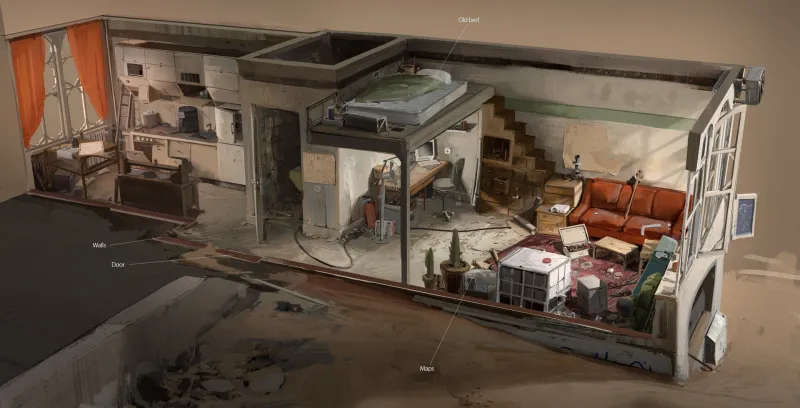
Photo: abandoned apartment room scattered belongings post-apocalyptic, via cdna.artstation.com
The first time you walk through an abandoned apartment in Metro Exodus, you probably do what most players do: scan for loot, check the corners for threats, and move on. The crafting system rewards speed. The hostility of the world encourages efficiency. You develop habits fast.
But somewhere around your second playthrough — or maybe your first, if you're the kind of player who slows down — you start to notice something. The apartment isn't just a container for resources. It's a document. The overturned furniture tells you which direction people fled. The handwritten notes tucked into a drawer tell you how much warning they had. The child's drawing still pinned to the wall tells you something about what they were trying to hold onto when everything started falling apart.
Metro is teaching you to read. And most players don't realize they're being taught until the lesson is already over.
Environmental Literacy as a Design Goal
The phrase "environmental storytelling" gets thrown around a lot in gaming criticism, and at this point it's in danger of losing meaning. Every game with a map and some scattered collectibles claims to do it. But there's a difference between placing objects in an environment and constructing an environment that rewards interpretation.
The distinction comes down to coherence and trust. In a lot of games, environmental storytelling means "we put a skeleton next to a locked chest so you'd have a chuckle." The object exists to deliver a single, self-contained joke or beat. There's no larger system it belongs to. You don't need to develop any interpretive skill to receive it — you just need to look.
Metro's approach is more demanding. The environments are designed as archaeological sites. To understand what you're looking at, you need to synthesize multiple pieces of evidence — the layout of a space, the state of its contents, the relationship between objects, the context provided by everything you've seen before this room. It asks you to think the way an actual survivor would think: not "what does this tell me?" but "what does all of this, together, tell me?"
That's a genuinely different cognitive task. And the franchise builds toward it incrementally, starting with relatively legible scenes in 2033 and growing progressively more subtle and complex through Last Light and into Exodus.
What the Surface Actually Shows You
The outdoor environments in Metro Exodus are where this design philosophy gets its most demanding workout. Inside the tunnels of Moscow, the storytelling is compressed by necessity — small spaces, dense detail, clear human scale. Out on the surface, 4A Games has to work harder to make ruins feel inhabited rather than decorated.
They pull it off, and here's specifically how: the surface environments are designed around process, not just result. You don't just see a collapsed bridge. You see the vehicles that were on it when it collapsed, positioned in ways that suggest the direction of traffic, which suggests what people were trying to do — whether they were evacuating or converging. You don't just see a burned farmhouse. You see what burned and what didn't, which tells you something about how quickly it happened and whether anyone had time to take anything with them.
This is the kind of reading that archaeologists and forensic investigators do professionally. Metro makes it intuitive by giving players enough practice that the interpretive process becomes second nature. By the time you reach the Caspian chapter, you're not consciously analyzing environments — you're just understanding them, the way you understand a conversation without consciously parsing grammar.
How This Compares to the Competition
Fallout is the obvious comparison point for American players, and it's instructive. The Fallout franchise does environmental storytelling with genuine craft — the skeletons frozen in the moment of the blast, the pre-war advertisements that comment ironically on the post-war reality, the notes that fill in the lives of people who didn't make it.
But Fallout's environmental storytelling tends toward the explicit. The scenes are usually self-contained, the irony is usually legible on first encounter, and the broader world context is delivered through terminals and loading screen text that tells you what you're seeing. It's excellent work, but it doesn't require the same kind of sustained interpretive engagement that Metro demands. Fallout is a museum with good placards. Metro is a dig site.
The Last of Us is a closer comparison in terms of emotional register, and in some ways it's the strongest competitor to Metro's approach. Naughty Dog's environmental design is meticulous and genuinely moving. But even The Last of Us tends to stage its environmental stories — the hospital nursery, the university dormitory — as discrete scenes with clear emotional targets. You're meant to feel a specific thing. Metro is less directive. It shows you the evidence and trusts you to arrive at your own conclusions, which means different players come away with genuinely different interpretations of what they've seen.
The Reason It Feels Real
Here's the thing about a world that feels "lived-in" versus one that feels "constructed": the difference isn't really about the quantity of detail. It's about whether the details answer questions you didn't think to ask.
A constructed world puts details where you're going to look. A lived-in world puts details everywhere, because life doesn't organize itself around where the camera is pointing. Metro's environments feel authentic not because they're exhaustively detailed — though they are — but because the details exist in relationship to each other in ways that generate meaning beyond what any single object could carry alone.
When you find a pair of children's shoes near a ventilation shaft in a flooded tunnel section and spend the next ten minutes quietly hoping you don't find what you're afraid you might find, that's not a scripted emotional beat. That's you, using the interpretive skills the game has spent hours building in you, arriving at a conclusion the designers trusted you to reach.
That's what environmental literacy actually looks like. And once Metro teaches it to you, you'll find yourself doing it in other games — and noticing, with some disappointment, how rarely those games have done the work to make it worth your while.